The separation of Church and State was a great innovation of the Founders of the United States. Having seen the way that an institutional church is corrupted by power, they put in place a system where religion and statecraft maintain separate spheres of influence. But there are some who take "separate spheres of influence" to mean more than simple separation. For instance, a FEMA photographer who required a church group to remove their "faith-based" shirts before interviewing them for a video.
To their credit, the FEMA chief has apologized for the incident. But it is a good reminder that there are those who take "separation" to mean "hostility".
Showing posts with label church. Show all posts
Showing posts with label church. Show all posts
Saturday, May 22, 2010
FEMA Photographer refuses to photograph anyone in a "faith-based" shirt
Wednesday, February 10, 2010
Risking jail by taking his daughter to church
One point of pride for Americans is our Freedom of Religion. No one can be prosecuted for attending any religious ceremony, or professing any faith. But it seems that at least one judge believes he has the power to prevent a father from taking his daughter to church. After baptizing his daughter without her mother's consent, Joseph Reyes was ordered to only expose her to Judaism. He is ignoring the order.
I have been ordered by a judge not to expose my daughter to anything non-Judaism,” Reyes said. “But I am taking her to hear the teachings of perhaps the most prominent Jewish Rabbi in the history of this great planet of ours. I can’t think of anything more Jewish than that.”It is horrible that these parents are using their religion to fight over their daughter. But that does not justify this action by an overreaching judge. Freedom of Religion is fundamental to our freedoms.
...Reyes and his wife are divorcing and are involved in a bitter custody fight. She says he always agreed to raise their child as Jewish. He says that’s not true.
“My daughter should be exposed to the religions of both my wife and myself … When she gets to the appropriate age, she’s going to make her own decisions on how she wants her relationship with God to ultimately be,” said Reyes.
Monday, January 11, 2010
Malaysia churches firebombed over the name of God
Sometimes, in the effort to give others the benefit of the doubt, Westerners underestimate the differences between the thinking of Western democracies and the Islamic world. There is little that illustrates the difference between Western ideas of religious freedom and Islamic ideas of it than a rash of bombings in Malaysia against Christian churches. The reason? Doctrine? Culture? Historical gripes? Nope. It is over the use of the Malaysian name of God, which happens to match the Arabic "Allah".
Two more churches in Malaysia were firebombed Sunday, bringing the total to six since a court ruled that non-Muslims can use the word "Allah" as a term for God...In recent months, authorities in Malaysia have seized more than 20,000 Bibles because they refer to God as Allah.As we confront Al Qaeda and other extremist Islamic groups, we need to keep in mind these differences in perspective.
The seizures have fed fears among minority groups, which see signs of encroaching Islamic fundamentalism in the predominantly Muslim but multiracial country.
Thursday, July 16, 2009
Who Chooses the Church?
The news about the Episcopal Church formally lifting the ban on ordaining practicing homosexuals as bishops makes me wonder if Americans are losing their ability to sense hypocrisy. Americans demand the right to customize everything to our tastes. Don't like a black or white iPhone? We can recolor it. Don't like the standard burger? Have it your way! Don't like the way your house looks? We can match any color you do like! But when God makes a claim about how He wants His Church to work, we feel a right to contradict Him and decide He can't have it the way He wants.
I am sick of debating the biological/psychological origins of homosexuality, the political implications of it, and the comparative studies of homosexuality in ancient Israel versus today. They are beside the point. The Bible is quite clear on how God wants the Church to work.
Here is a trustworthy saying: If anyone sets his heart on being am overseer [a pastor or elder], he desires a noble task. Now the overseer must be above reproach, the husband of but one wife, temperate, self-controlled, respectable, hospitable, able to teach, not given to drunkenness, not violent but gentle, not quarrelsome, not a lover of money. He must manage his own family well and see that his children obey him with proper respect. (If anyone does not know how to manage his own family, how can he take care of God's church?) He must not be a recent convert, or he may become conceited and fall under the same judgment as the devil. He must also have a good reputation with outsiders, so that he will not fall into disgrace and into the devil's trap.Please note, heterosexuality is not the only qualification in this list. A pastor must also be shown to be gentle, not a big drinker, a good father, a long-time believer, and must have a good reputation (which even disqualifies anyone who has a bad reputation that is NOT EARNED). But heterosexuality and monogamy are clearly qualifications. Ordaining practicing homosexuals is ignoring this prescription (as would ordaining an alcoholic or someone with a child who is a criminal or even someone unwilling to entertain in their home).
1Timothy 3:1-7
But does God really care about this "fringe issue"? Doesn't He give people a lot of latitude in their styles of worship? The Bible shows Him giving latitude to the masses, and not to those who would be leaders. Consider the death of Aaron's sons who God killed for worshiping Him in a way other than He had prescribed. It was not that they were being disrespectful, not that they were worshiping other gods, not that they were even coming with some unconfessed sin. They simply worshiped in a way other than God required. Or in the New Testament consider Ananias and Sapphira who were killed for lying about the offering they gave to God. It was not that the offering was insufficient, it was not that the money offered was in any way "bad", it was not even that there was some other defect in them. They simply lied about the offering, presenting it in a way that was other than God required.
The ordination of bishops is the selection of leaders for God's church. Doesn't He have the right to decide who gets to serve and who does not?
Monday, April 13, 2009
Hard Cases: Church "outs" an anonymous blogger
It is not unusual for someone to have a problem with the leadership of their local church. Leaders - including pastors and elders/overseers/trustees/deacons/etc. - make mistakes or often are doing the right thing and simply not explaining themselves. My own church has been moving from a pure Congregational model to a more closed model in a way which has been disturbing to me. Scripture has fairly clear guidelines for dealing with such concerns, which generally goes, "talk to the problem person singly, then with one other person, then with the elders, and then before the Congregation." (Yes, Seminarians, I am aware there are many more verses and a whole history here. Feel free to expound in the comments.)
But what happens when a church dispute comes up against anonymous blogging? Should church leaders honor the unspoken agreement of the internet and let the blogger remain unknown? Isn't such a move in line with First Amendment rights of free speech? Or should church leaders seek out the blogger and discipline him/her for not following scripture.
In the case linked above, church leadership erred on the side of control and had a police officer (who also worked church security) seek out and expose the blogger. The blogger was then expelled from the church, as per 1 Corinthians 5:4-5.
To me, this seems like a hard case. On the one hand, the blogger clearly was not following scripture. On the other hand, it appears the pastor himself - in his zeal to discipline - clearly crossed the line to find the offender. Either way, Christ's name is being dragged through the mud, and the gospel becomes a laughing-stock among the world.
What would you do, as either the pastor or the congregant?
Friday, March 20, 2009
BIBLE STUDY: Raising your hands in church
 I come from a conservative background of the Protestant church tradition. My friends and family tend to be non-demonstrative lot at church, with little more than the occasional "A-men!" when we are REALLY moved. So, it has bothered me to see a particular phenomenon from the charismatic/pentecostal tradition starting to appear in church - the raising of hands. This action, usually done during singing, always seemed showy to me and distracting. But, it is important to separate "it bothers me" from "it is wrong." So, I decided to do some research into the phenomenon, and see what the Bible had to say.
First, I found an amazing number of defenses of the practice online. The best explanation of why people lift their hands in worship came from here.
- Lifting the hands is a symbol of surrender.
- Lifting the hands is a symbol of trust.
- Lifting the hands is a symbol of openness.
- Lifting the hands is a symbol of affection.
 The "surrender" symbolism is especially significant, it seems to me. In my own observation, I have noticed that the lifting of hands is especially common among women in the churches I have visited. Surrender is something that is culturally-appropriate for women in America - giving oneself to your husband, to your children, to your church, to your friends - but is less culturally-appropriate to the rugged individualism which governs men in our culture.
In looking through scripture, there appears to be three classifications for the raising of hands:
1. Prayer (5 references): 1 Timothey 2:8, Lamentations 3:40-42, Psalm 28:1-2, Psalm 141:1-2, Nehemiah 8:5-6
2. Worship (2 references): Psalms 63:3-4, Psalm 134:1-3
3. Study (1 reference): Psalm 119:48
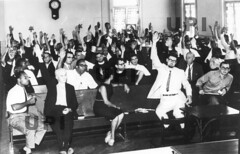 Going by the pure number of references, it is clear scripture favors the raising of hands as a posture of PRAYER over worship. However, it is equally clear that scripture does call for the lifting of hands in worship. One interesting note from the same article listed above may be significant in this.
The Hebrew word for hand is the word yad; yadah means to “throw out the hand” or to worship with extended hands.Which may indicate that the extension of hands to an object of adoration is simply an assumption of Hebrew culture.
Another article noted one other aspect of the raising of hands - which C.S. Lewis also applies to kneeling in The Screwtape Letters - is that movements and positions of the body influence the attitude of the mind and heart.
But of note also is this article which makes the claim that all raising-of-hands references in the old testament are related to the sacrificial system, and thus are inappropriate to a Christian world where sacrifices have been fulfilled by the death and resurrection of Christ. The author dismisses the 1 Timothy 2:8 scripture as a figurative passage asking for "clean hands" of Christians.
 Overall, the middle road here appears to be that the raising of hands is a Biblical practice. It is permitted and encouraged by Scripture, but is not commanded or required. This article does a good job of summarizing what I have come to: worshiping with lifted hands is appropriate and scriptural, but should be done with an eye toward its potential impact on others around you. If you are in a service with people who will find it distracting, or who will be tempted toward showing off, then keep your hands down. If you are in a service where people are comfortable or ambivalent to the practice, go right ahead.
For me, this study has been a comfort. It reminds me that my own prejudices should not rule how I view others, or their relationship with God. Surely, some raise their hands to be showy. But others do so with sincere hearts, looking to praise God and obey scripture.
Wednesday, March 11, 2009
CT Church Government Bill dies
The bill reported on by CRChair and I over the last couple of days which would have given the legislature the power to regulate church government, is apparently dead. The uproar appears to have been more than the bill's authors expected, and even after the bill was shelved there are protests planned in Hartford.
Is "Evangelicalism" dying?
Hat Tip to Mod-Blog friend Nick for pointing out a very interesting commentary from the Christian Science Monitor about the Evangelical movement. The basic thesis is that "Evangelicalism" is dying and will see a collapse in terms of numbers, influence, and money in the next decade. This is blamed on an increasingly secular society and the failure of "evangelical" Christians to engage the larger culture.
WHY IS THIS GOING TO HAPPEN?Now, I am what most would call an "Evangelical." I am a bible-believing, born-again Christian who attends a church that believes the same and I take part in the larger "Christian culture" of music, movies, etc. I am not sure if the article writer is correct so much as I wonder if he is irrelevant. While I may be an "Evangelical," I have no particular love for any "Evangelical" culture. I love the Gospel of Jesus Christ. If that is preached by "Evangelicals" or "Orthodox" or "Charasmatic" or "House Church" people, I am satisfied. I will admittedly be uncomfortable with the worship styles of some others (I don't even raise my hands during singing). But "uncomfortable" doesn't bother me in looking at the future, so long as the Cross of Christ is preached.
1. Evangelicals have identified their movement with the culture war and with political conservatism. This will prove to be a very costly mistake. Evangelicals will increasingly be seen as a threat to cultural progress. Public leaders will consider us bad for America, bad for education, bad for children, and bad for society...
2. We Evangelicals have failed to pass on to our young people an orthodox form of faith that can take root and survive the secular onslaught. Ironically, the billions of dollars we've spent on youth ministers, Christian music, publishing, and media has produced a culture of young Christians who know next to nothing about their own faith except how they feel about it...
What do you think?
Tuesday, March 10, 2009
CT Representatives respond on Church Government Bill
CRChair reported yesterday on a bill being considered by the Connecticut legislature to mandate church governmental forms, especially Catholic churches. In the last 24 hours, several CT Mod-Bloggers contacted our state representatives on the subject and we got back some responses!
Thank you for your notes on Raised S.B. No. 1098 AN ACT MODIFYING CORPORATE LAWS RELATING TO CERTAIN RELIGIOUS CORPORATIONS.And yet another for your consideration.
I agree that this legislation is an inappropriate invasion of religious freedom. I will actively oppose this bill and any other attempt of the state to interfere in the internal affairs of the Catholic Church or any religion.
I do not believe Connecticut should dictate to any religion how they should govern themselves, nor give the state broad investigatory powers whenever any allegation is brought forward. Religious freedom is one of the cornerstones of our democracy, and SB-1098 clearly violates the separation of church and state. All religions should have the right to govern themselves as their clergy and parishioners see fit—not have decisions forced on them by politicians in Hartford.
I am happy to report that following days of public pressure, the chairs of the Judiciary Committee have decided to table the bill and postpone a scheduled public hearing. However, given the late notice of the postponement and the importance of the issue at hand, Republican legislators will be holding an informational hearing of our own tomorrow (Wednesday March 11th) at 12:00pm in room 2C of the Legislative Office Building.
I encourage you to attend this informational hearing. Sign up will begin at 9:30am in the lobby of the Legislative Office Building at 300 Capitol Avenue in Hartford. Attending legislators will allow members of the clergy to testify first and then open the hearing for public comment.
-Dan Debicella, CT State Senator
Thank you for reaching out to me on this extremely troubling billAnd yet another
before the legislature's Judiciary Committee. First and foremost,
please know that I support you and the Church 100%. You have my
commitment to oppose this bill.
Why the legislative majority of the State of Connecticut thinks it's ok to dictate how the Catholic Church must govern itself is beyond comprehension. I believe that the legislature has no right to interfere in the structure of the Church and though this bill is directed only at the Catholic Church today, as Bishop Lori has pointed out, it could be forced on other denominations in the future. This is, at best, unconstitutional. At worst, it's an underhanded attempt to silence the Catholic Church. The state has no business controlling religion.
You should send your thoughts to Judiciary Committee Co-chairs, Senator Andrew McDonald and Rep. Michael Lawlor. They need to know how people feel about what they have proposed.
As you may already be aware, the Judiciary Committee public hearing scheduled for tomorrow (Wednesday, March 11th) on S.B. 1098, AN ACT MODIFYING CORPORATE LAWS RELATING TO CERTAIN RELIGIOUS CORPORATIONS has been canceled. However, in an effort to give the people who have contacted us an opportunity to express their concerns with this bill, many of which we share, the members of the House and Senate Republican
Offices, will be going forward tomorrow with an informational hearing on this bill starting at 12:00 pm. The hearing will be held in room 2C of the Legislative Office Building in Hartford and overflow rooms will be available.
Sign up for the hearing will start at 9:30 am in the first floor lobby of the Legislative Office Building. We will hear from Church officials first and then open it up for public comment. We are inviting anyone who has contacted us on this bill so we can let them know they can be heard on this issue tomorrow. We will also be inviting our Democrat colleagues to join us. If you have any questions please let me know.
- Jason Perillo
State Representative
113th District - Shelton, CT
As you may already be aware, the Judiciary Committee public hearing scheduled for tomorrow (Wednesday, March 11th) on S.B. 1098, AN ACT MODIFYING CORPORATE LAWS RELATING TO CERTAIN RELIGIOUS CORPORATIONS has been cancelled. However, in an effort to give the people who have contacted us an opportunity to express their concerns with this bill, many of which we share, the members of the House and Senate Republican Offices, will be going forward tomorrow with an informational hearing on this bill starting at 12:00 pm. The hearing will be held in room 2C of the Legislative Office Building in Hartford and overflow rooms will be available.
Sign up for the hearing will start at 9:30 am in the first floor lobby of the Legislative Office Building. We will hear from Church officials first and then open it up for public comment. We are inviting anyone who has contacted us on this bill so we can let them know they can be heard on this issue tomorrow. We will also be inviting our Democrat colleagues to join us. If you have any questions please let me know.
Sincerely,
Rep. Lawrence Miller, CT State Representative
Monday, March 09, 2009
Good tips to prepare for a Church emergency
The reported church shooting from this past weekend has left a lot of people wondering how to prepare their own houses of worship for such an attack. This site has up a good list of questions to ask yourself and to ask your church leadership.
1. Does your church have a series of written, known, and practiced emergency plans?Please note, this list does not mean that Mod-Blog endorses the policies and procedures (or even assumptions) of the parent site. But it is a good checklist to think about for the future. Even if you decide that some of the assumptions (i.e. a security force in a church is appropriate) is not for your house of worship.
2. How secure is your children’s ministry?
3. Does your church have security?
4. Does your church have a warm relationship with the local police?
5. Does your church have a policy for potentially dangerous people?
Friday, December 19, 2008
Church Threatens to Make Sins Public
A Floridian is claiming that the church that she used to attend is threatening to talk publicly in their church about her "sins" as she is currently in a sexual relationship with her boy friend. She was recently divorced and her husband and children still attend the church, but she now attends a different church. The Church doesn't want to comment on the issue, but recently sent her a letter laying out that they are moving to the final step in church discipline of bringing an unrepentant sinners sins in front of the congregation. They base this on their reading of Matthew chapter 18.
Tuesday, September 09, 2008
Is the Mega-Church Movement in Decline?
USA Today has us an interesting article on their perceived decline in "Mega Churches" in America. They classify any church of more than 2,000 people a Mega Church. The most interesting statement in the article is:
"The megachurch story is not really about growth, it's about shifting allegiances. People want to feel good about who they already are," says Philip Goff, director of the Center for the Study of Religion and American Culture at Indiana University in Indianapolis. "If church is too challenging or not entertaining, they'll move on."
I really don't agree with this opinion. The shift I see away from churches is more from people who don't feel challenged. I wonder if this is just the difference between those who are "seekers" and those who are already "believers".
Sunday, July 06, 2008
How should churches handle sex offenders?
Every good church preaches that God welcomes anyone and that we are all sinners and that only Christ can truly heal and regenerate a repentant sinner. All good churches want to be houses of worship for all people who are seeking Christ, and want to have their doors open as much as possible. But, what do you do, when opening your doors to everyone, means opening yourselves up to proven dangerous men, especially those convicted of molesting children? It is something that had not occurred to me before, and apparently I am not alone.
It's the same question facing a group of Protestants in Carlsbad, Calif., right now, members of the Pilgrim United Church of Christ who learned in late January that 53-year-old Mark Pliska, a convicted sex offender, wanted to worship with them. The normally progressive, welcoming congregation balked at the notion, and the resulting firestorm forced pastor Madison Shockley to tearfully ask Pliska not to come to services until the church could sort things out. (Shockley says he will announce the church's decision in mid-May.) "Nothing in my almost 30 years of ministry has prepared me to turn somebody away," Shockley told the local paper. But Shockely's biggest surprise wasn't that a sex offender wanted to worship, but that so many members of his congregation had been sexually abused as children; he estimated one in four of female congregants and one in 10 men. Having an offender in the pews with them on Sunday - even one who had served his time, registered with the authorities and voluntarily identified himself to the pastor - was too big a hurdle for these former victims, Christians or not.The simple answer is obvious: the church should let in even convicted murders and sex offenders, as God is the god of all people. But we are told to be "innocent as doves, but wily as snakes" in scripture, and thus need to find ways of allowing them in without exposing the church to danger. How do we do that? I am not sure. I am interested to hear the opinions of other Mod-Bloggers on this, especially those who have served as pastors.
Thursday, May 22, 2008
Dressing for Church
It has long been a controversy between the young and the old. "What is appropriate attire for church?" Some eras, it has been the old pushing for formality, while the young push for informality. Other eras, it has been the old comfortable in their informality, and the young pushing for nicer clothes and more formal experiences. The current swing appears to have the older Christians generally pushing for "dressing up" and younger Christians pushing for "dressing down." The two theories appear to go like this:
Dressing Up/Formality: Church is where we come to worship God. Part of worship is telling the object of worship how important they are by your dress. This is why we dress up when going on a date with someone new, and why we wear elaborate dresses and tuxedos to a wedding. God is the most important being in the universe and our lives individually, so we should wear our best when coming to worship him.
Dressing Down/Informality: Church is where we come to worship God. God is not one who looks at the outward person, but who looks at the heart. Our worship is a set of actions welling up out of an internal reality of love and devotion, and our outward appearance has little bearing on the inward reality. While we do not want to overtly disrespect God with our outward appearance (Paul advises us to "dress modestly"), it is simply not a matter that otherwise is important. So worshipers should be comfortable coming to worship in whatever clothing works for them.
I have spent most of my life in the latter group, and did not understand the former. "If God was not concerned about David dancing naked before him," I thought, "It will be no great issue to him whether I show up in a suit and tie, or a tshirt and jeans." But recently God has been working on my heart, and showing me that at least some of this attitude in me has been pure selfishness. I did not want to wear uncomfortable clothes, so I was looking for excuses to wear comfortable ones. Thus, for me, it has been more important of late to dress up a bit to show God that I put him first. But this is just my walk, and I do not plan to press this "revelation" on anyone else. Perhaps for others, "dressing up" is a sin of pride, for example, and God may ask them to dress down for a time.
What do you think? Where do you fall? Do you think church (or synogogue, etc.) should be a place of dressing up/formality or dressing down/informality? I am interested to read the reactions of other Mod-Bloggers. I know we don't all see it the same way.
Saturday, May 17, 2008
City to Church: STOP Feeding the Homeless!
There are times when it makes sense to speak up. And there are times when it is wisest to say nothing and look for your own solution. Take, for example, this case where a town had asked local churches to help with homelessness. One church began feeding the homeless, and now the town is asking them to stop.
Peace Lutheran Church has been delivering breakfast items like cereal and juice boxes every Thursday to homeless people in Jubilee Park.The town needs to realize that they need to address the underlying causes of these issues, and not attack the church for making the problems visible.
But city council says the free food is also drawing in drug dealers and addicts, who have taken to congregating on the front steps of a seniors' centre next door.
The church says it won't stop.
Saturday, April 26, 2008
"Not My Ministry" Syndrome
Back in the 80s and 90s, there was a lot of talk in business about NIH Syndrome: Not Invented Here. Among companies, there was an unwillingness to accept change that came from the outside. Any approach or new idea that did not come from within the company was rejected out of hand, and often a perfectly good solution to a problem would be abandoned because it was not an in-house solution. Apple was particularly guilty of this, and got a lot of bad press for it. But as the decades waned, the companies willing to adopt outside ideas and acquire other companies grew and strengthened, and those who did not failed. Apple was the rare exception to survive, but that did so by overcoming "Not Invented Here" by embracing outside ideas like Intel Chips, a UNIX core, the Webkit engine, etc.
I have been observing over the last decade that evangelical churches have begun their own version of this that I call "NMM Syndome" -- Not My Ministry. Churches which have maintained successful ministries for decades are abandoning them because they were not the idea of any of the current pastoral staff. Current ministries which are successful - but done by the laity - are ignored and starved for funds and attention. And any ministry which has existed for more than 10 years is actively discouraged, unless it happens to be the baby of one of the current pastors, elders, or deacons. If it is "Not My Ministy" then it is inherently a bad thing. Even trends embraced by churches from the outside are no longer "Helping Women in Need", but now has to be branded as "Mary Smith's Outreach to Redeemed Women". Everything is about whose fingerprints are on a ministry, and not about the fruit it is brearing
I guess this is part of human nature. But why does the church embrace a way of thinking which has already been shown to be a failure in business? Are you seeing a similar trend at your church? Am I wrong and this is nothing new? Let me know in the comments below.
Friday, March 21, 2008
Thursday, February 21, 2008
NFL Reverses Decision and Allows Churches to Show SuperBowl
The NFL has decided to reverse its decision to enforce its copyright laws against Churches that show the superbowl. It will now be alright for religious organizations to show the superbowl, regardless of screen size, as long as they don't charge a fee and do it in a space that is regularly used by the organization. This seems like a good decision to me. The more people who can build good memories of watching the Super Bowl with friends, the more people will be more likely to watch the game in the future.
Monday, January 28, 2008
Two Major Religous Leaders Die
Two major religious leaders in the world died in the past couple of days. Gordon Hinckley, the President of the Church of Jesus Christ of Ladder Day Saints died at the age of 97. He did not have a particular illness and was said to have basically died of old age. The Church which is also known as Mormonism has 13 million members in the world. Also, Christodoulos the Archbishop of the Greek Orthodox church died at the age of 69. There are 15 million Greek Orthodox Christians in the world today. (10 million of which are in Greece) It is interesting that these two men would basically die at the same time.
Friday, December 07, 2007
Is Christian Tithing Biblical?
I have been having some discussions recently with my friends about tithing at church. One of my friends who graduated from seminary said to me that teaching on tithing isn't found in the New Testament. I decided to do some checking myself and dusted off my book from Larry Burkett on the Bible and Money where he lays out all the verses in the bible that talk about money in a topical format. I was surprised that I think there was only one verse in the New Testament that mentioned tithing and it had no real teaching on that subject for a believer. Google provided me with a link to an interesting article which I would encourage you to read. It is mostly aimed at those who teach that if you don't tithe to the church then you are sinning. But it lays out a lot of scripture and argues that among other things, there isn't any evidence that Jesus tithed. The most interesting minor thing in the article is on how Jesus paid his Temple tax. Jesus states that he does not need to pay the temple tax, but will do so to avoid offending anyone. In the end, he doesn't even pay it out of his own money, but this is where the story of the coins in the fish's mouth comes in. I encourage you all to read this article even though it is long (44 pages when pasted into a Word document). Lest you think he argues not to give any money to church, he doesn't say that at all. He just says that what you decide to give to the church is an offering, not a tithe. You shouldn't feel obligated by scripture to give any certain percentage.
Subscribe to:
Posts (Atom)